
Segmented Fins Tube is manufactured to enhance the heat transfer efficiency without significant rise in pressure drops in comparison to traditional plain tubes. The segmentated fins can be applied onto the base tube in various ways and welded to the tubes to transfer heat more efficiently. Common uses of the segmented fins tube include the application in boilers, economizers, waste heat recovery systems, HRSG systems and Heat Exchangers.
Segmented Fin Tubes
Manufactured heat transfer components for high efficiency thermal management within industrial heating and cooling processes are Segmented Fin Tubes. In contrast to conventional continuous Finned Tubes, the design of segmented fins includes intermittent fin segments allowing for increased turbulence within heat transfer mediums, thus optimizing heat transfer, and minimizing fouling buildup.
As a premier manufacturer and exporter, we manufacture high quality Segmented Fin Tubes for use in heat exchangers, boilers, economizers, air coolers, waste heat recovery systems and power generation applications. We employ a variety of advanced manufacturing technologies that include state-of-the-art welding, precise fin forming and forming technologies and stringent quality control procedures along with tailor made solutions per our customer's needs.
In many industries around the world, segmented fin tubes are implemented to achieve high efficiency in heat transfer while also maintaining performance in reliable and heavy duty operations with higher pressures and temperatures.
What Are Segmented Fin Tubes?
Segmented fin tubes are particular finned tubes that are designed where individual sections of the fin are welded around the outer periphery of a tube rather than a continuous strip. The arrangement of the segmented fin helps the design induce artificial flow disruptions which significantly enhance the heat transfer performance.
This unique design helps:
- Increase thermal efficiency
- Improve heat exchange rates
- Minimize pressure drop
- Help resist build up of fouling and dust.
- Permit ease of cleaning
- Improve operating performance over time.
These devices are ideally suited to application where the flow of air needs to be carefully managed and resistance to contaminants is essential.
Table of Content
- What Are Segmented Fin Tubes?
- Types of Segmented Fin Tubes We Manufacture
- Technical Specifications of Segmented Fin Tubes
- Materials Available for Segmented Fin Tubes
- Advantages of Segmented Fin Tubes
- Applications of Segmented Fin Tubes
- Why Choose Us as Your Segmented Finned Tube Supplier?
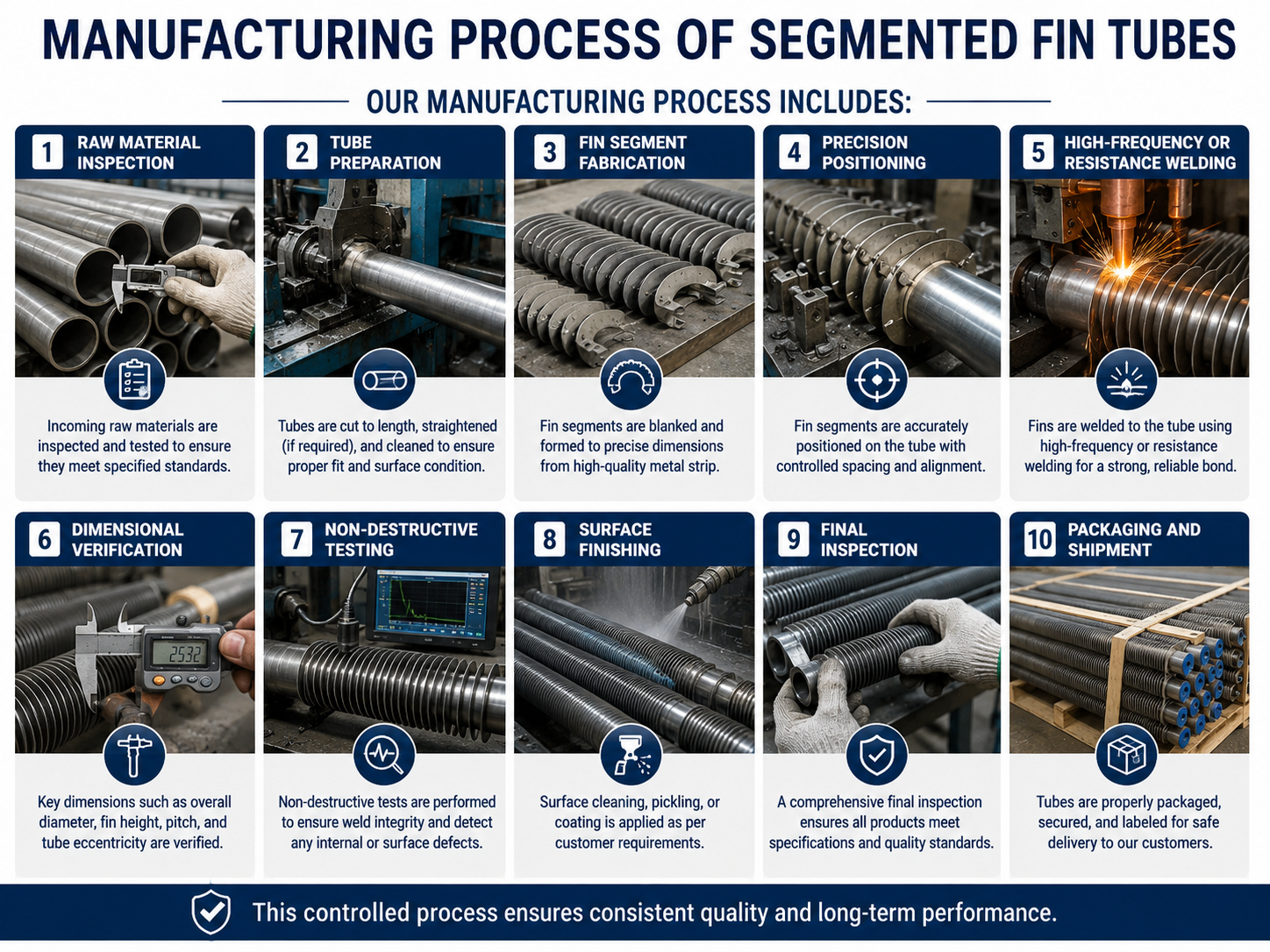
- Manufacturing Process of Segmented Fin Tubes
Types of Segmented Fin Tubes We Manufacture
Welded Segmented Fins Tube
Welded Segmented Fins Tube designs are manufactured by permanently welding individual fin segments onto the tube surface. This process creates excellent thermal contact between the fin and tube, ensuring efficient heat transfer under demanding operating conditions.
Key Benefits:
Helical-Segmented Finned Tube
A Helical-Segmented Finned Tube combines the benefits of helical fin geometry with segmented fin construction. The helical arrangement promotes better fluid flow characteristics while the segmented structure improves turbulence and heat transfer.
Applications include:
This design is particularly effective when maximum heat extraction is required within limited installation space.
I-Type Segmented Finned Tube
The I-type segmented finned tube features straight fin segments arranged around the tube surface in a structured pattern. This configuration provides excellent heat transfer performance while maintaining mechanical strength.
Advantages include:
Many industries prefer I-Type Segmented Finned Tube designs for applications involving dusty gases and challenging operating conditions.
Segmented Spiral Fins
Segmented Spiral Fins are manufactured by arranging segmented fin elements in a spiral pattern around the tube circumference. This design maximizes surface area while promoting turbulent flow for enhanced heat transfer.
Benefits include:
Segmented Spiral Fins are widely used in energy recovery and process heating applications.