
Carbon Steel, Stainless, Duplex & Copper Alloy Heat Exchanger Tubes
Dinesh Tube India supplies heat exchanger tubes from Mumbai to heat exchanger fabricators, EPC contractors, refineries, power plants and plant maintenance teams in India and abroad. We supply carbon steel, stainless steel, duplex, copper alloy and nickel alloy tubes in straight lengths and U-bends, to ASME / ASTM specifications, with an EN 10204 3.1 mill test certificate.
This page helps you choose the right tube material for your service, and links to each material's own page. Send us your tube schedule (material, OD, BWG, length or U-bend radii, quantity) for a quote.
What Are Heat Exchanger Tubes?
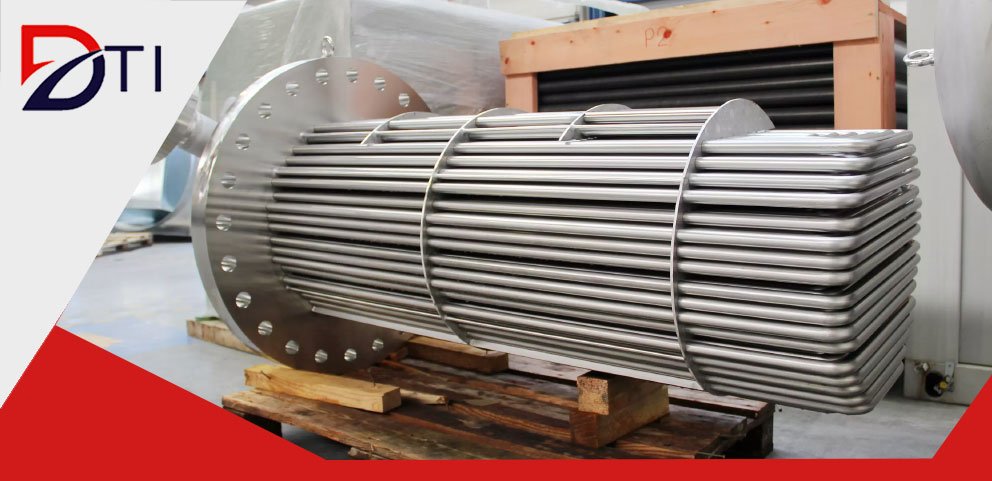
Heat exchanger tubes are the thin-walled tubes inside shell-and-tube heat exchangers, condensers, coolers and feedwater heaters. One fluid flows through the tubes while another flows around them in the shell, and heat passes through the tube wall. Because the tubes are expanded or welded into tube sheets, they are made to close tolerances on outside diameter and wall thickness, and must be ductile enough to roll without cracking.
The tube material is chosen from the fluids on both sides: their corrosiveness, temperature, pressure and any risk of fouling. A wrong choice leads to early tube leaks and costly re-tubing, so the material table below is the first step in any heat exchanger tube enquiry.
Heat Exchanger Tube Materials
Choosing Tube Material by Service
Typical selections only. The exchanger designer confirms the material for the actual fluids, temperatures and code.
Re-tubing an exchanger or building a new bundle? Send your tube schedule (material, OD, BWG, length or U-bend radii, quantity) to kamlesh@dineshtube-india.com or call +91 83559 10913. You can also send an enquiry.
Heat Exchanger Tube Sizes & BWG Chart
Most common ODs: 15.88 mm (5/8"), 19.05 mm (3/4"), 25.40 mm (1"), 31.75 mm (1 1/4") and 38.10 mm (1 1/2").
Types of Heat Exchanger Tubes
Carbon Steel HX Tubes
Stainless Steel HX Tubes
Alloy Steel HX Tubes
Cu-Ni & Nickel Alloy HX Tubes
Heat Exchanger Tube Applications
See also boiler tubes and air preheater tubes.
Heat Exchanger Tubes: FAQs
What are heat exchanger tubes?
Heat exchanger tubes are the thin-walled tubes in a shell-and-tube heat exchanger, condenser or cooler. One fluid flows inside the tubes and another flows around them in the shell, so heat passes through the tube wall. They are ordered by outside diameter and wall thickness (often in BWG) and must be expanded or welded into tube sheets, so dimensional accuracy and ductility are important.
Which material is best for heat exchanger tubes?
It depends on the fluids. Carbon steel (SA179, SA214) is the economical choice for clean, non-corrosive service such as oil coolers and steam. Stainless steel 304/316 suits mildly corrosive process fluids. Duplex resists chloride stress corrosion cracking. Cupro-nickel (90/10, 70/30) and titanium are used for seawater cooling. Nickel alloys such as Inconel, Monel and Hastelloy are used for severe chemical service.
What is the difference between SA213 and SA249 stainless tubes?
ASME SA213 covers seamless ferritic and austenitic alloy tubes, including TP304 and TP316. SA249 covers welded austenitic stainless tubes. Welded SA249 tubes have uniform wall and lower cost and are widely used in heat exchangers; seamless SA213 is chosen where the design or client requires seamless tube.
What does BWG mean for heat exchanger tubes?
BWG (Birmingham Wire Gauge) is the traditional way to state tube wall thickness: the higher the number, the thinner the wall. For example, 14 BWG is 2.11 mm, 16 BWG is 1.65 mm and 18 BWG is 1.24 mm. Wall can be ordered as minimum wall or average wall, which affects the tolerance.
What is a U-bent heat exchanger tube?
A U-bent tube is bent into a U so both ends fit into a single tube sheet, which lets the tube bundle expand freely and be pulled out for cleaning. U-tubes are made in a range of bend radii, and the bend area is often stress relieved, especially in stainless and copper alloys, to reduce the risk of stress corrosion cracking.
What is the most common heat exchanger tube size?
Under TEMA practice, 3/4 in. (19.05 mm) and 1 in. (25.4 mm) OD are the most common, usually in 14 or 16 BWG wall. Smaller 5/8 in. tubes are used in compact exchangers, and larger sizes in fouling or low-pressure-drop service.
Export Destinations for Heat Exchanger Tubes
We export heat exchanger tubes to the Middle East (UAE, Saudi Arabia, Qatar, Kuwait, Oman, Bahrain, Iraq, Jordan), Africa (Nigeria, Egypt, South Africa, Kenya, Ghana, Algeria, Morocco, Tunisia), Asia (Japan, South Korea, Singapore, Malaysia, Indonesia, Thailand, Vietnam, Philippines, Bangladesh, Sri Lanka), Europe (Italy, Spain, Portugal, France, Netherlands, Belgium, Poland, Romania, Turkey, United Kingdom), and the Americas (United States, Canada, Mexico, Brazil, Chile, Peru, Colombia, Argentina).